Samsung appears to be making an interesting choice with the next generation of its flagship smartphone cameras. Instead of reviving one of the more distinctive camera technologies it used years ago, the company has reportedly decided to leave variable aperture out of the Galaxy S27 series.
The move is notable not simply because a rumored feature has disappeared. It could also tell us something about Samsung’s broader priorities for its 2027 flagships: fewer mechanical complications, tighter control over camera-module size and cost, and greater reliance on sensors and computational photography.
According to an ETNews report published on August 13, Samsung tested variable-aperture camera modules during Galaxy S27 development but ultimately decided not to adopt the technology in the upcoming lineup.
Samsung itself has not announced the Galaxy S27 series yet, so the information should still be treated as an industry report rather than a confirmed specification.
What Is Samsung Reportedly Dropping?
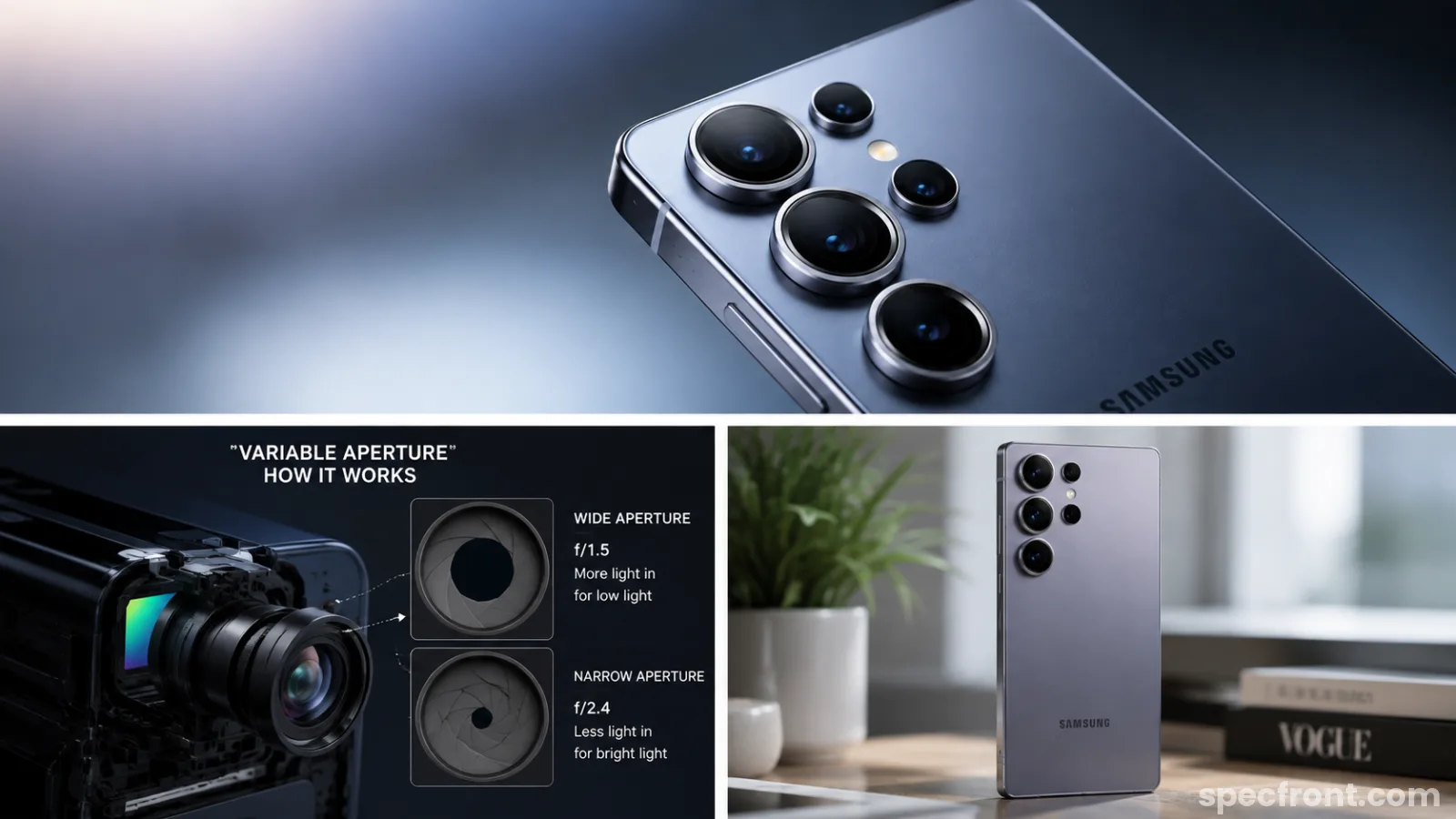
A variable-aperture camera changes the physical size of the lens opening depending on the shooting situation.
That matters because aperture affects how much light reaches the camera sensor. A wider opening can be useful in darker environments, while a narrower aperture gives the camera greater control when plenty of light is available.
According to ETNews, Samsung had been evaluating camera modules involving suppliers including Samsung Electro-Mechanics and MCNEX before deciding not to put the system into the Galaxy S27 lineup.
The report points to a combination of higher component cost, a thicker camera module and relatively modest image-quality benefits as factors behind the decision.
That combination is important. A feature can look impressive on a specification sheet while still being difficult to justify if it increases size and manufacturing complexity without producing an equally noticeable improvement in everyday photos.
This Is Not Samsung’s First Experiment With Adjustable Aperture
For long-time Galaxy users, variable aperture is actually familiar technology.
Samsung used a Dual Aperture system on the Galaxy S9 and Galaxy S9+. The camera could switch between F1.5 and F2.4 depending on lighting conditions.
Samsung’s own Galaxy S9 launch material for India explained that the lens opened to F1.5 in darker situations and switched to F2.4 when more light was available.
That gives the Galaxy S27 rumor an interesting historical angle.
Samsung would not have been experimenting with an unfamiliar idea. It already knows how adjustable-aperture systems behave inside smartphones and what advantages and compromises come with moving lens hardware.
The reported decision to leave it out of the Galaxy S27 therefore looks less like Samsung being unable to build the technology and more like a calculation that it is not currently worth the trade-offs.
The Bigger Story May Be Samsung Simplifying Its Camera Hardware
Variable aperture is only one part of the emerging Galaxy S27 camera picture.
A separate ETNews report from August 3 claimed Samsung is preparing three rear cameras across the Galaxy S27 lineup, including the Ultra model.
According to that report, the rumored Galaxy S27 Ultra configuration would include:
The report says Samsung may remove the separate 3x telephoto camera that has been part of recent Ultra models.
None of this has been officially confirmed, but if both reports prove accurate, a pattern begins to emerge.
Samsung may be trying to make the S27 Ultra camera system more streamlined rather than simply adding more hardware every generation.
Dropping one rear camera while also abandoning a mechanically complex variable-aperture mechanism could reduce component count, internal space requirements and manufacturing costs.
That does not automatically mean the camera experience will be worse. The real question will be whether Samsung can compensate with improved sensors, cropping, image fusion, AI processing and better lens quality.
Why Camera Count Is Becoming Less Useful as a Measure of Quality
A few years ago, adding another camera was an easy way for smartphone makers to advertise an upgrade.
That approach is becoming less meaningful.
A phone with four rear cameras is not automatically better than one with three. What matters more is whether each camera provides useful focal lengths and consistent image quality.
If Samsung can produce high-quality intermediate zoom levels from a high-resolution main sensor and its 5x telephoto camera, removing a dedicated 3x camera may be less noticeable than the specification suggests.
The same logic applies to variable aperture.
A mechanical aperture can offer genuine photographic benefits, but modern smartphone cameras also use multi-frame HDR, computational exposure, night processing and sensor cropping to solve problems that previously depended more heavily on lens hardware.
The success of Samsung’s strategy will therefore depend on the final results rather than how many physical components appear on the specification sheet.
There Is Still a Reason Enthusiasts May Be Disappointed
Despite those arguments, variable aperture would have given the Galaxy S27 Ultra something unusual.
Most flagship smartphone camera improvements today focus on sensor size, megapixels, zoom ranges and AI processing. A physically adjustable lens would offer photographers another hardware-level method of controlling an image.
It could also affect depth of field in certain situations and give the camera more flexibility under changing lighting conditions.
That is why the feature attracted attention when rumors about its possible return began circulating.
Samsung’s decision, if the report is accurate, suggests the company concluded that those advantages were not significant enough to justify the additional space and expense.
Apple Could Make Samsung’s Decision More Visible
There is also a competitive angle.
The same ETNews report says Apple is preparing variable-aperture technology for its iPhone 18 Pro models.
That information is also unconfirmed by Apple, so it should be treated as a report rather than an official feature announcement.
Still, if Apple ultimately introduces the technology while Samsung skips it, variable aperture could become a visible point of comparison between two of the biggest premium smartphone families.
It would not necessarily mean the iPhone takes better photos. Image quality depends on an entire camera pipeline, including the sensor, optics, stabilization, image processing and software.
But it could create an interesting marketing contrast: Apple adding a new mechanical camera control while Samsung moves toward a more simplified hardware arrangement.
What This Could Mean for Galaxy S27 Buyers in India
For Indian buyers, the more important issue may eventually be price rather than the missing feature itself.
Premium flagship prices have climbed significantly, and extra camera components increase hardware and manufacturing costs.
If Samsung is simplifying the camera system partly to control component expenses, the important question will be whether those savings help prevent another major price increase — or whether Samsung uses the available space and budget for improvements elsewhere.
Potential buyers should therefore avoid judging the Galaxy S27 Ultra solely by whether it has variable aperture or three versus four rear cameras.
The things worth watching closer to launch will be:
Those will have a much greater effect on everyday ownership than one missing specification.
The Galaxy S27 Is Still Far From Official
Samsung has not announced the Galaxy S27 family, its final camera configuration or pricing.
ETNews currently expects the lineup to arrive in the first half of 2027, which leaves Samsung plenty of time to adjust hardware before mass production.
Reports this early in a product-development cycle should always be read with some caution. Components can change, suppliers can change and features tested internally do not always reach retail devices.
Still, information about components being tested — and later rejected — can provide an early look at the decisions Samsung is making behind the scenes.
SpecFront Take
The most interesting part of this report is not that Samsung may remove variable aperture.
It is that Samsung appears to be asking a broader question: does adding more camera hardware still produce enough value to justify the cost and space it consumes?
If the Galaxy S27 Ultra really moves to three rear cameras and skips variable aperture, Samsung will have more pressure to prove that software, sensor improvements and smarter processing can replace hardware that users can easily count on a spec sheet.
That could be a smart decision if the final camera produces better images while keeping the phone thinner or controlling its price.
But if Samsung removes hardware without delivering noticeable improvements elsewhere, enthusiasts are likely to see the changes as cost-cutting rather than optimization.
For now, the Galaxy S27 camera story is less about a feature being cancelled and more about how Samsung appears to be redefining what a flagship camera system actually needs.