Ask this question in 2027 and it might not even make sense anymore — Apple's first folding iPhone is already on the horizon, and the hardware gap between flagships has all but disappeared. But right now, in mid-2026, the two platforms are still different enough that picking the wrong one can genuinely annoy you for the next three or four years. Not because one phone is "better" — they're both excellent — but because they're built around different bets on how you want to live with your device.
This is a breakdown of where each side actually pulls ahead, and how to match that to the way you use your phone.
Who's winning the numbers game
Android isn't just more popular — it's dominant. It holds somewhere around 70–72% of the global smartphone market, a lead built on covering every price point at once — from sub-₹10,000 entry-level phones in India to premium foldables well past ₹1,50,000 — and everything between. iPhone's strength is concentrated rather than broad — it leads the premium tier in the US, Japan, and pockets of Europe, backed by the highest resale values and the most loyal ownership base in the industry.
Neither number tells you which phone to buy. They just explain why the two ecosystems keep evolving in different directions.
Chip and camera: the gap has narrowed, not closed
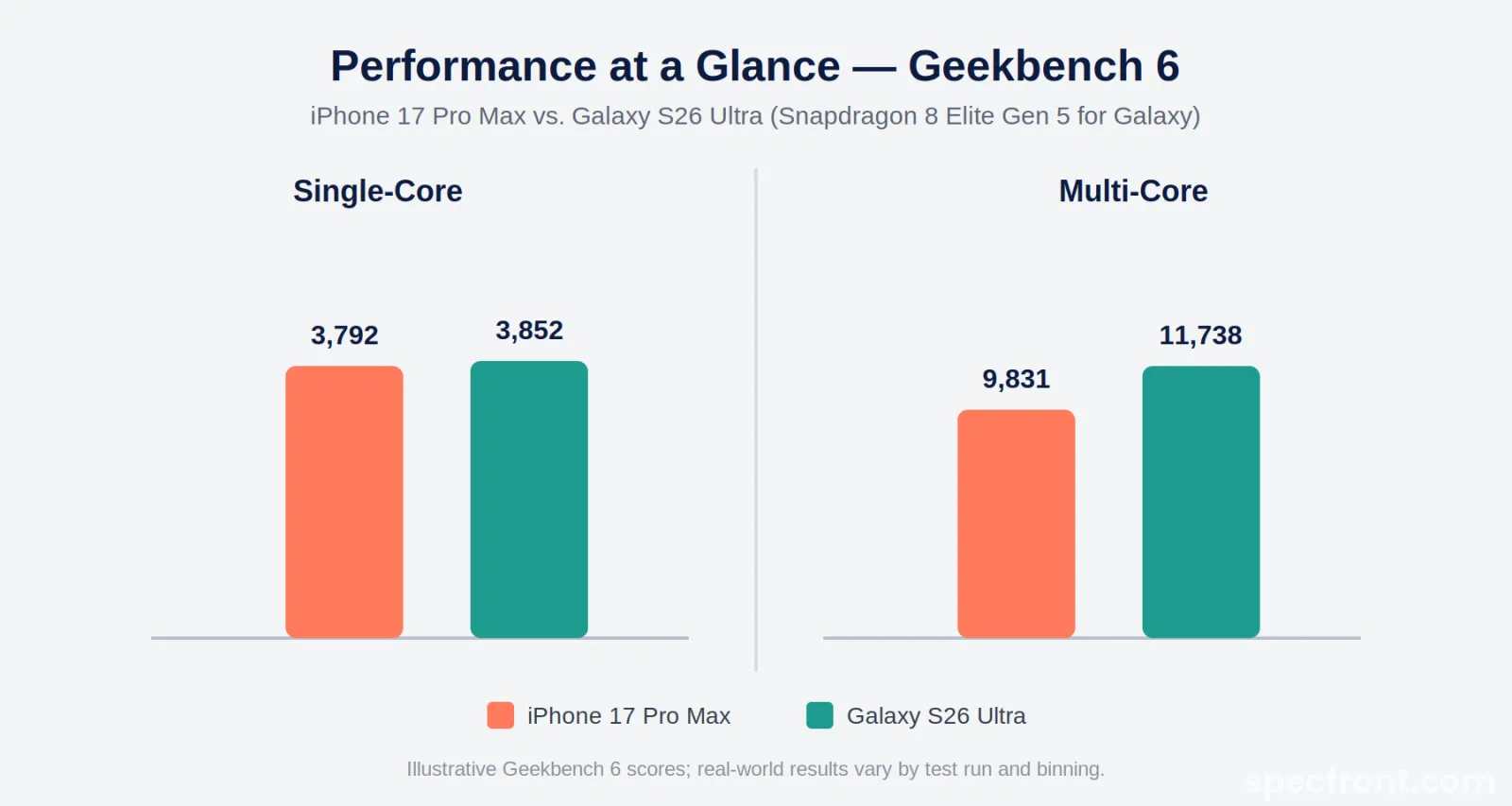
The A19 Pro (in the iPhone 17 Pro and Pro Max) and Qualcomm's Snapdragon 8 Elite Gen 5 (the chip inside the Galaxy S26 Ultra and most 2026 Android flagships) are now close enough that benchmark charts flip depending on the day. Apple traditionally wins single-core tests, and mostly still does — but some recent Snapdragon 8 Elite Gen 5 results have edged ahead even there, which would've been unthinkable a couple of generations ago. Where Android still separates itself clearly is multi-core throughput and sustained GPU performance, which matters more for gaming and heavier multitasking than for everyday app snappiness.
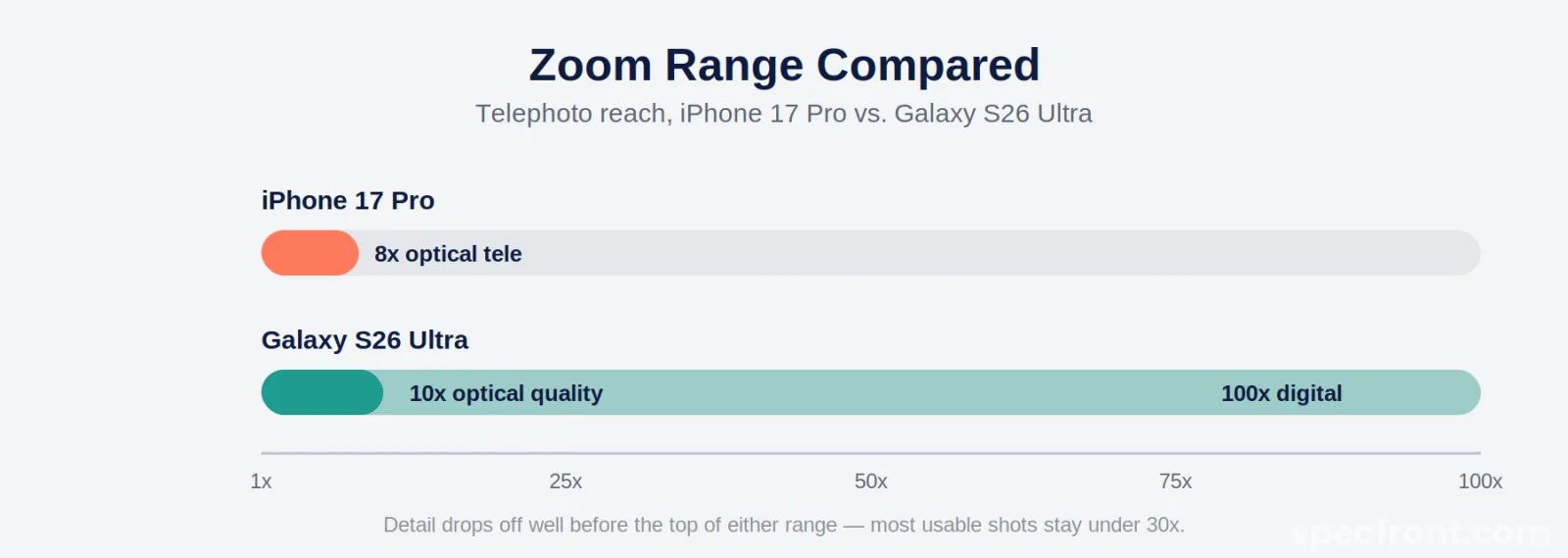
Cameras follow a similar pattern of "different strengths, not a clear winner." iPhone remains the safer choice for video — consistent color science, reliable stabilization, footage that looks the same whether you're filming your kid's birthday or a short film. Android, and Samsung specifically, wins on raw reach: the Galaxy S26 Ultra's 100x Space Zoom is a genuinely different capability than anything Apple offers, even if usable detail drops off well before 100x. Android flagships also tend to pack higher-resolution sensors and more lens variety.
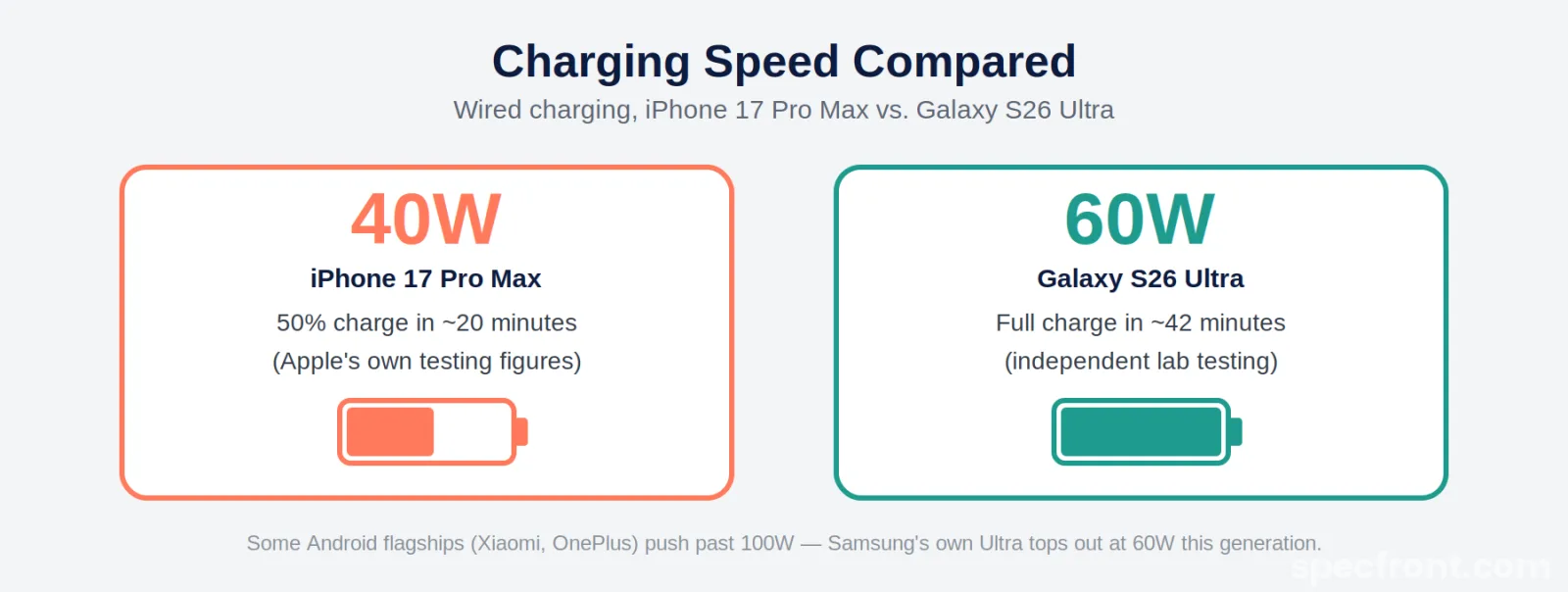
Charging and battery are where the philosophical difference is starkest. iPhones sip power efficiently and last all day, but charge slowly by comparison. Android flagships lean the opposite way — bigger batteries paired with 45–100W+ wired charging that can take a phone from empty to full in well under an hour. If you've ever been annoyed waiting for an iPhone to charge, this alone might be worth switching for.
And then there's form factor. Foldables — the Galaxy Z Fold and Flip, Motorola's Razr line — are still an Android-only category. That's expected to change once Apple's foldable iPhone ships later this year, but as of today, anyone who wants a folding phone is choosing Android by default.
Software: polish vs. flexibility, still
iOS 26 (with iOS 27 landing later this year) is what it's always been: the most consistent, most tightly integrated software experience in mobile. If you own a Mac, an Apple Watch, or AirPods, the way those devices talk to each other — Continuity, AirDrop, Handoff — is still unmatched. Apple Intelligence keeps improving, but it's telling that a lot of reviewers, even ones who prefer iPhone hardware, reach for Google's Gemini when they need an AI assistant to actually get something done.
Android 16/17 is the platform for people who want to shape their phone rather than adapt to it — custom launchers, real widgets, side-loading, and multitasking that scales properly to foldables and tablets. Gemini feels more capable here for a simple reason: it's Google's product running on Google's platform, with fewer walls between the assistant and the rest of the OS. Pixel gets new features first; Samsung has caught up on software longevity, now matching Google's seven-year update commitment on its flagship Galaxy S line.
The one place cross-platform friction has genuinely eased is messaging. RCS support means the blue-bubble/green-bubble divide isn't the dealbreaker it used to be, even if iMessage still holds a few exclusive tricks.
Matching the phone to the person
iPhone makes sense if you're already inside Apple's ecosystem (Mac, iPad, Watch), you care more about resale value and a "just works" experience than raw specs, or you want the most dependable video camera in your pocket.
Android makes sense if you want the best hardware for your money, you live in Google's apps (Gmail, Maps, Photos, Gemini), you want a foldable or another form factor Apple doesn't offer, or you just like configuring things your own way.
What it actually costs to own
Both ecosystems have gotten serious about longevity — seven years of updates is now standard on Pixel and Galaxy S-series flagships, and Apple typically matches or beats that in practice even without publishing a formal number. Where iPhone pulls ahead is resale: it holds value so much better at trade-in time that the real multi-year cost gap is smaller than the sticker prices suggest. Android's cost advantage shows up if you keep a phone for years without upgrading, or buy mid-range rather than flagship.
So, which one wins?
Neither, universally. If ecosystem integration, simplicity, and resale value matter most to you, iPhone is the better bet. If you value choice, price-to-performance, camera zoom range, foldables, or AI flexibility, Android — specifically a current flagship like the Galaxy S26 Ultra or Pixel 10 Pro — is the stronger pick.
Honestly, the decision usually isn't about specs at all. It's about which ecosystem you're already invested in and who you text every day. Pick a current flagship from either side and it's genuinely hard to make the wrong call.
- Already deep in Apple's ecosystem? Stick with the iPhone 17 series — the iPhone 17 Pro launched at ₹1,34,900 in India and has since eased closer to ₹1,27,000.
- Want the most flexibility or the best deal? Look at the Pixel 10 Pro (₹1,09,999 at launch) or Galaxy S26 Ultra (₹1,39,999 at launch, now available for less on offer).
- Working with a tighter budget? A mid-range Android under ₹25,000 or a well-priced refurbished iPhone will serve you well.
Pros and Cons
iPhone
| Pros | Cons |
|---|
| Tightest ecosystem integration (Mac, iPad, Watch, AirPods) | Slower wired charging |
| Best resale value in the industry | No foldable option yet (expected later in 2026) |
| Most consistent, reliable video camera | Apple Intelligence still trails Gemini for many everyday tasks |
| Long real-world software support | Less customization, no sideloading |
| Polished, "just works" experience | Premium pricing across the lineup |
Android
| Pros | Cons |
|---|
| Best price-to-performance across every tier | Software experience varies by manufacturer skin |
| Faster wired charging (45–100W+) | Generally lower resale value than iPhone |
| Longer zoom range and more camera versatility (e.g., Samsung's 100x Space Zoom) | Video quality/consistency can vary more between models |
| Foldables and other exclusive form factors | Ecosystem integration less tight across non-Google/Samsung devices |
| Deep customization and sideloading | Update policies still inconsistent outside Pixel/Galaxy S flagships |
| 7-year software support now standard on Pixel and Galaxy S |